Tide vs Starling vs Monzo: which business account wins?
Three of the UK's most-used business current accounts, compared on the things that actually change your day-to-day banking — not just the headline free plan.

Written by Priya Raman — Reviews lead
Former business banking onboarding analyst, 7 years in UK fintech
Fact-checked by Tony Hargreaves · Last reviewed: 20 September 2026
Tide, Starling and Monzo turn up on almost every "best business bank account" shortlist in the UK, and for good reason: all three built mobile-first accounts aimed squarely at sole traders, freelancers and small limited companies, and all three offer a free tier. But they are not interchangeable, and the differences that matter are mostly invisible until you actually need them — a cash deposit, an overdraft, or a claim on FSCS protection.
This comparison sets out where each one is genuinely different. We are a Tide referral partner and may earn a commission if you open a Tide account through a link on this page — see our full disclosure above. That relationship does not change the comparison below; where Starling or Monzo is the better fit, we say so.
At a glance
The table below is the whole comparison in miniature. The detail behind each row — and the situations where the obvious answer is wrong — follows underneath it.
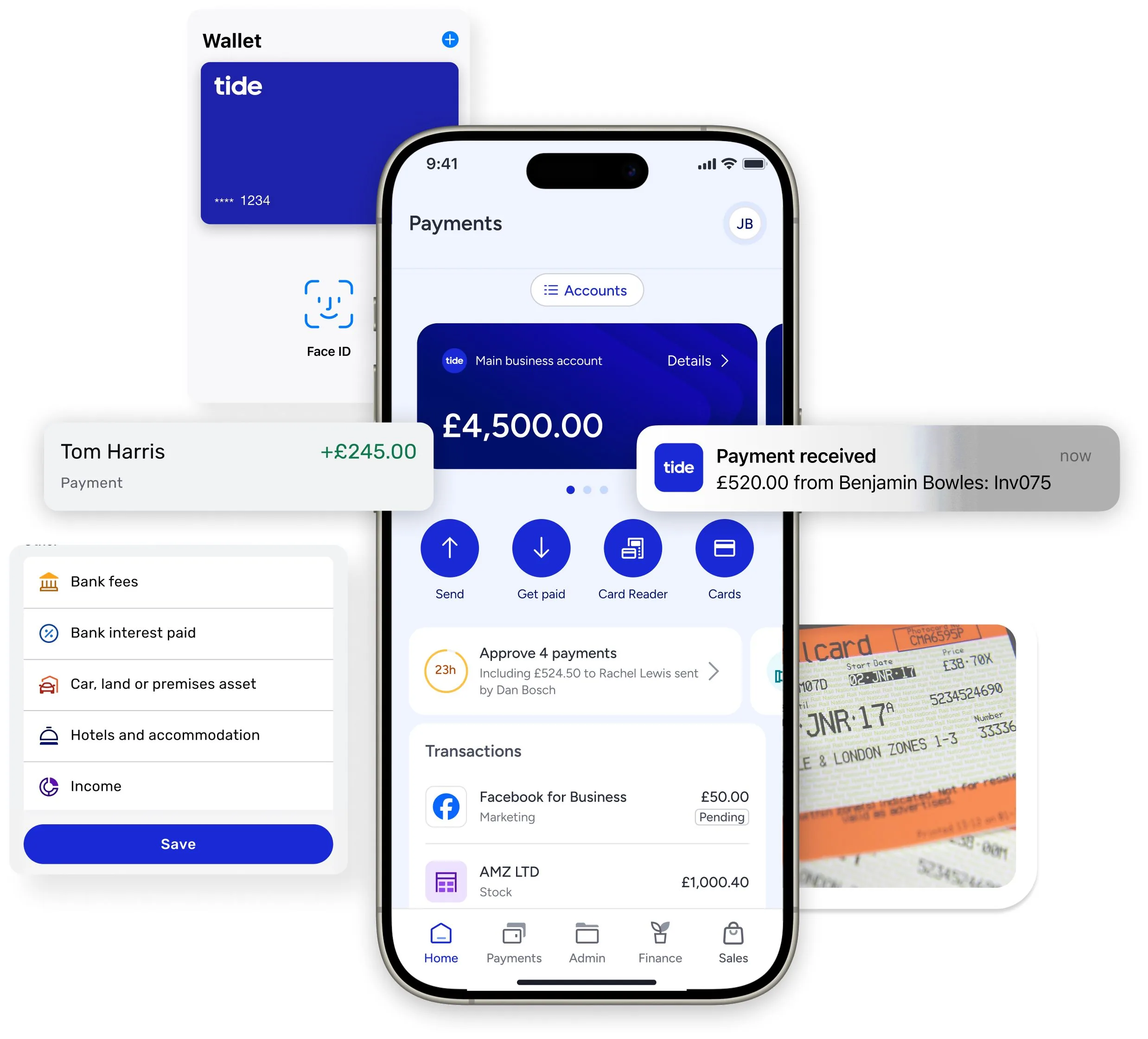
| TideE-money institutionOur pick | Starling BankUK-licensed bank | Monzo BusinessUK-licensed bank | |
|---|---|---|---|
| Regulatory status | E-money platform; accounts provided by ClearBank, FSCS-eligible up to £120,000 | Full UK bank licence; FSCS-protected up to £120,000 | Full UK bank licence; FSCS-protected up to £120,000 |
| Monthly plans | Free plan plus several paid tiers with added transfers, cashback and perks | Free for most small businesses; no tiered paid plan structure | Free plan plus a paid tier with extra features |
| Cash deposits | Available on paid plans via the Post Office, fee applies — check current terms | Post Office and PayPoint network, fee applies | Post Office network, fee applies |
| Invoicing & expenses | Built into the app: invoicing, expense capture, accounting connections | Basic tools; leans on third-party marketplace apps | Basic tools; leans on third-party marketplace apps |
| Business savings | Instant Saver with a variable rate, held with a partner bank | Instant and fixed saver options | Instant access savings pots |
| Lending | Partner-provided lending and invoice finance, not from Tide's own balance sheet | Direct lending track record, including scheme-backed loans at times | Growing direct lending offering |
| Multi-user access | Team members and accountant access on paid plans | Additional cardholders and accountant access | Additional cardholders on paid tier |
| Who it suits | App-first businesses with low cash handling that want invoicing built in | Businesses that want a full bank, including cash handling and lending | Existing Monzo personal customers wanting a similar business experience |
| Open a Tide account |
Tide
E-money institution
Our pick- Regulatory status
- E-money platform; accounts provided by ClearBank, FSCS-eligible up to £120,000
- Monthly plans
- Free plan plus several paid tiers with added transfers, cashback and perks
- Cash deposits
- Available on paid plans via the Post Office, fee applies — check current terms
- Invoicing & expenses
- Built into the app: invoicing, expense capture, accounting connections
- Business savings
- Instant Saver with a variable rate, held with a partner bank
- Lending
- Partner-provided lending and invoice finance, not from Tide's own balance sheet
- Multi-user access
- Team members and accountant access on paid plans
- Who it suits
- App-first businesses with low cash handling that want invoicing built in
Starling Bank
UK-licensed bank
- Regulatory status
- Full UK bank licence; FSCS-protected up to £120,000
- Monthly plans
- Free for most small businesses; no tiered paid plan structure
- Cash deposits
- Post Office and PayPoint network, fee applies
- Invoicing & expenses
- Basic tools; leans on third-party marketplace apps
- Business savings
- Instant and fixed saver options
- Lending
- Direct lending track record, including scheme-backed loans at times
- Multi-user access
- Additional cardholders and accountant access
- Who it suits
- Businesses that want a full bank, including cash handling and lending
Monzo Business
UK-licensed bank
- Regulatory status
- Full UK bank licence; FSCS-protected up to £120,000
- Monthly plans
- Free plan plus a paid tier with extra features
- Cash deposits
- Post Office network, fee applies
- Invoicing & expenses
- Basic tools; leans on third-party marketplace apps
- Business savings
- Instant access savings pots
- Lending
- Growing direct lending offering
- Multi-user access
- Additional cardholders on paid tier
- Who it suits
- Existing Monzo personal customers wanting a similar business experience
Structure and features described qualitatively where exact fees vary by plan and change over time. Tide's own pricing pages are the only authoritative source for its current fees — figures checked 20 September 2026. Starling and Monzo figures are based on their published account features at the same date and should be re-checked on their own sites.
Regulatory status: the difference that matters most
Starling and Monzo hold banking licences in their own name; Tide does not, and that is a genuine structural difference worth understanding, even though it now makes less practical difference to FSCS cover than it used to. Starling and Monzo are UK-licensed banks, so eligible deposits are protected by the Financial Services Compensation Scheme up to £120,000 per person, per institution, in the event the bank fails. Tide is authorised as an electronic money institution, not a bank in its own name; its business current accounts are provided by ClearBank, a UK-authorised bank, so eligible deposits held there also attract FSCS protection up to £120,000 — subject to eligibility rules and to aggregation with any other balances you hold with ClearBank. Some Tide balances that sit outside the ClearBank current account are safeguarded rather than FSCS-protected, which is a different, non-government-backed mechanism. Read our explainer on Tide and FSCS protection before deciding whether that distinction matters for the balances you hold.
Fees and plans
All three publish a free plan aimed at low-volume, low-cash businesses, and all three make money on paid tiers or add-ons rather than the free account itself. Tide's paid plans layer on faster transfers, cashback and multi-user access. Starling keeps its structure simpler with fewer named tiers. Monzo sits between the two. None of this is static — providers change pricing with notice, and the only reliable source for current numbers is each provider's own pricing page. Our Tide fees explained page breaks down Tide's current structure in detail; we do not attempt to reproduce exact Starling or Monzo pricing here because we cannot keep a third party's pricing table current with the same confidence we have in our own Tide checks.
Cash handling
If your business takes cash — a market stall, a salon, a trades business — this is worth checking properly before you open any of these accounts. Starling and Monzo both support Post Office deposits and Monzo also uses PayPoint; Tide supports Post Office deposits on its paid plans, with limits and a per-deposit fee. None of the three is built primarily around cash the way a branch-based high street bank is, so if cash is a large share of your turnover, it is worth comparing all three against a traditional business bank account too.
Lending and savings
Starling has the longest and most direct track record of lending to small businesses from its own balance sheet, including participation in government-backed schemes at various points. Monzo has expanded its own lending offering more recently. Tide does not lend directly in the same way; it surfaces partner-provided lending and invoice finance options inside the app instead. If you expect to need a business loan or overdraft from the same provider that holds your current account, that is a genuine point in Starling's favour. All three offer some form of instant-access business savings account, useful for setting aside tax money.
App experience and built-in tools
Tide has put more of its product effort into invoicing, expense capture and accounting integrations built directly into its own app, which suits businesses that want to avoid paying for a separate invoicing tool. Starling and Monzo have clean, well-reviewed apps but lean more on their third-party app marketplaces for invoicing and deeper bookkeeping features. Neither approach is objectively better — it depends whether you would rather have fewer subscriptions or more specialised individual tools.
Our verdict
There is no single winner here, and treating this as a horse race misses the point. If you want a full bank with FSCS protection on the whole balance, established lending and solid cash handling, Starling is the stronger structural choice. If you already bank personally with Monzo and want a similar business experience with growing lending options, Monzo is a reasonable pick. If you want an app-first account with invoicing and expenses built in, do little or no cash banking, and are comfortable with Tide's e-money structure and its FSCS position, Tide is a strong fit — and it is the one we can offer with the REFER200 referral bonus.
Read our full Tide review for the hands-on detail on Tide specifically, and our wider shortlist if you want to see how a broader set of UK business accounts compares beyond just these three.
If you have already narrowed the choice to one rival, we have a dedicated, full-length head-to-head for each: Tide vs Starling, Tide vs Monzo, Tide vs Revolut, Tide vs Mettle, Tide vs HSBC Kinetic, Tide vs Barclays, Tide vs Lloyds, Tide vs ANNA, Tide vs Zempler and Tide vs Wise Business — or start from the comparison hub.
FAQs
- Tide business account funds are held at ClearBank and FSCS-protected up to £120,000.
- Independent and unaffiliated. We are not Tide, not a bank and we do not give financial advice.
- Offer terms checked against Tide's own T&Cs on 20 September 2026. Subject to change.
Ready to open the account?
Code REFER200 is applied automatically when you use the button below.
T&Cs apply. Eligibility criteria must be met. Read Tide's full REFER200 offer terms.