Tide vs Revolut Business: which one is even the right comparison?
Revolut Business and Tide were built to solve different problems. One is a multi-currency financial app for businesses that trade internationally; the other is a UK sterling current account for sole traders and small companies. The right choice depends far more on what currencies you touch than on which app looks slicker.

Written by Daniel Okoye — Compliance and regulation writer, fact-checker
ACCA-qualified accountant advising UK micro-businesses
Fact-checked by Tony Hargreaves · Last reviewed: 20 September 2026
Of all the accounts people cross-shop against Tide, Revolut Business is the one where the comparison itself needs the most care. Tide was built as a UK sterling current account for sole traders, freelancers and small limited companies who invoice domestically and want invoicing, expense tools and a savings account bundled in for free. Revolut Business was built as a multi-currency financial platform first and a UK current account second — it happens to also work as a domestic account, but that isn't the job it was designed for.
The honest framing is this: Revolut is the stronger choice if your business regularly holds, receives or spends in currencies other than sterling, and Tide is the stronger choice if you trade mainly in the UK, want cash-deposit options and built-in invoicing, and want your balance held in a UK-regulated bank rather than an e-money institution. We earn a commission from Tide links on this page and nothing from Revolut, so weigh our lean accordingly against your own currency exposure.
Plans and structure at a glance
| TideOur pick for UK-only tradingOur pick | Revolut BusinessBetter for multi-currency trade | |
|---|---|---|
| Entry plan | Free, £0/m, 5 free transfers then 20p each | Paid plans start from roughly £10/m at the time of writing — confirm on Revolut's pricing page |
| Higher tiers | Smart £12.49, Pro £27.49, Max £69.99 — allowance and FX perks scale up | Grow and Scale tiers add higher FX allowances, card issuing and API access |
| Multi-currency accounts | GBP current account only; 0% card FX fees on paid plans (2.75% on Free) | Hold, receive and convert 25+ currencies with local account details |
| Cash deposits | Post Office £2.50 up to £500 then 0.99%/0.5%; PayPoint 3% | Not supported — no cash deposit facility |
| Invoicing and bookkeeping | Built in on Free: invoices, payment matching, expense tags, receipt capture | Invoicing tools included; deeper accounting integrations on higher tiers |
| Savings | Instant Saver 2%–3.25% AER by plan | Savings vaults and similar tools vary by plan and currency |
| Regulatory status | Accounts provided by ClearBank, a UK-authorised bank | UK e-money institution status historically; verify current banking-licence status on Revolut's own site |
| Deposit protection | Eligible deposits FSCS-protected up to £120,000 | Funds safeguarded rather than FSCS-protected under e-money rules — confirm current status |
| Company formation | £14.99 including the Companies House fee | Not offered |
| Joining bonus | Up to £200 with partner code REFER200 | Varies by promotion; none as reliable or as large as Tide's partner offer |
| Open Tide with REFER200 |
Tide
Our pick for UK-only trading
Our pick- Entry plan
- Free, £0/m, 5 free transfers then 20p each
- Higher tiers
- Smart £12.49, Pro £27.49, Max £69.99 — allowance and FX perks scale up
- Multi-currency accounts
- GBP current account only; 0% card FX fees on paid plans (2.75% on Free)
- Cash deposits
- Post Office £2.50 up to £500 then 0.99%/0.5%; PayPoint 3%
- Invoicing and bookkeeping
- Built in on Free: invoices, payment matching, expense tags, receipt capture
- Savings
- Instant Saver 2%–3.25% AER by plan
- Regulatory status
- Accounts provided by ClearBank, a UK-authorised bank
- Deposit protection
- Eligible deposits FSCS-protected up to £120,000
- Company formation
- £14.99 including the Companies House fee
- Joining bonus
- Up to £200 with partner code REFER200
Revolut Business
Better for multi-currency trade
- Entry plan
- Paid plans start from roughly £10/m at the time of writing — confirm on Revolut's pricing page
- Higher tiers
- Grow and Scale tiers add higher FX allowances, card issuing and API access
- Multi-currency accounts
- Hold, receive and convert 25+ currencies with local account details
- Cash deposits
- Not supported — no cash deposit facility
- Invoicing and bookkeeping
- Invoicing tools included; deeper accounting integrations on higher tiers
- Savings
- Savings vaults and similar tools vary by plan and currency
- Regulatory status
- UK e-money institution status historically; verify current banking-licence status on Revolut's own site
- Deposit protection
- Funds safeguarded rather than FSCS-protected under e-money rules — confirm current status
- Company formation
- Not offered
- Joining bonus
- Varies by promotion; none as reliable or as large as Tide's partner offer
Tide figures checked against tide.co/pricing on 20 September 2026. Revolut's plan pricing and regulatory status change independently of us and have shifted before — confirm both on Revolut's own site before you decide.
The multi-currency question decides most of this
If you invoice clients in the US or the EU, buy stock from overseas suppliers, or hold a euro balance to avoid double-converting, Revolut's multi-currency accounts are a genuinely useful, well-built tool. It is one of the reasons the product has grown as fast as it has.
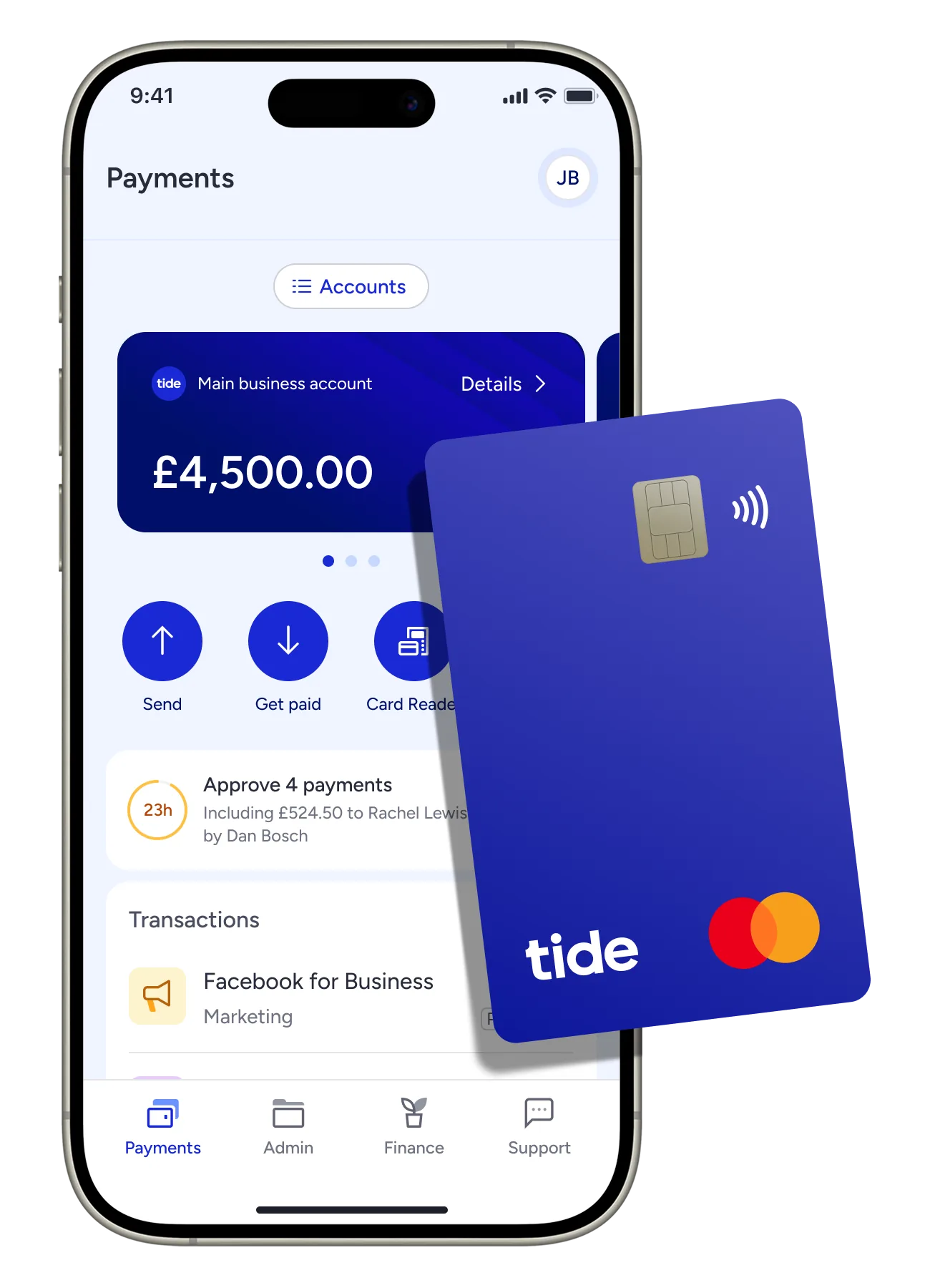
Consider a small e-commerce business invoicing £3,000 a month domestically and also receiving roughly €1,500 a month from EU marketplace sales. Routed through a GBP-only account, that euro income gets converted at whatever rate the receiving bank or platform applies, often with a poor margin baked in. Held in a Revolut euro balance instead, the business can hold the euros, pay euro suppliers directly, or convert at a time and rate of its choosing. That flexibility is worth real money to a business with genuine foreign-currency flow, and Tide has no answer to it — it is simply not what a GBP current account is for.
Now take the more common case: a UK-based tradesperson, consultant or small agency invoicing entirely in sterling to UK clients. None of Revolut's multi-currency machinery does anything for that business. What it actually needs is a low-cost sterling account with invoicing and expense tools, and on that measure Tide's Free plan at £0 a month — with invoicing, expense tagging and a savings account included — is hard for a paid Revolut plan to beat on price for equivalent domestic functionality.
Cash handling and regulatory status
Revolut Business has no cash deposit facility at all, which rules it out immediately as a sole operating account for any business that takes cash — a market stall, a tradesperson paid in notes, a small retailer. Tide's Post Office and PayPoint routes are not cheap at volume, but at least they exist.
The regulatory point matters more than it might first appear. Revolut's UK business accounts have historically sat under an e-money licence rather than a full banking licence, which means customer funds are legally safeguarded rather than covered by the FSCS depositor protection scheme in the way a bank balance is. Revolut has publicly pursued a full UK banking licence, and its status may have changed by the time you read this, so check Revolut's own site for where that stands today rather than relying on any fixed statement here. Tide's accounts, provided by ClearBank under sort code 04-06-05, sit on the bank-deposit side of that line: eligible deposits can attract FSCS protection up to £120,000, subject to eligibility and aggregation rules. Our guide to Tide and FSCS protection explains exactly what qualifies, and you can check either firm's current permissions on the FCA Register.
Three businesses, worked through in pounds
A UK-only sole trader plumber invoices domestic customers by bank transfer and takes the odd card payment on-site, with no foreign currency exposure at all. On Tide Free, that's £0 a month provided he stays under five transfers, or a few pounds of 20p overage if he doesn't — either way, invoicing and expense tagging are included. On Revolut, he'd be paying for a plan (roughly £10 a month or more at the time of writing, though check Revolut's current pricing page) to get invoicing and card issuing, for currency features he will never touch. There is no version of this profile where Revolut is cheaper.
A small import business buys stock from a supplier in China priced in US dollars, worth roughly $4,000 a month, and sells to UK customers in sterling. Converting that $4,000 through a UK bank's standard card or transfer FX rate could easily cost 3–4% in hidden margin — £100–£160 a month. Revolut lets the business hold a USD balance, convert when the rate is favourable, and pay the supplier directly in dollars, often at a meaningfully better rate than a domestic bank's standard FX spread; the exact saving depends on the plan and the day's rate, so it's worth checking Revolut's live rates rather than assuming a fixed percentage. Tide has no equivalent tool — its only concession to foreign currency is waiving the 2.75% card FX fee on paid plans, which doesn't help with supplier payments in dollars at all.
A UK consultancy with one recurring EU client invoices around €1,200 a month to a single client in France and otherwise trades entirely in sterling. This is the more marginal case: the euro income is real but small, and the admin of running two accounts to receive one client's invoices may not be worth it. Holding a Revolut euro balance to receive that one invoice and convert it at a convenient time could save perhaps £20–£40 a month versus receiving it through a UK bank's standard conversion, which starts to justify at least a free or low-tier Revolut account run alongside Tide as the main sterling account — rather than replacing Tide altogether.
Onboarding and KYB: what each one actually asks
Tide's application is built around a UK sole trader or limited company: proof of ID, a selfie check, your business details and, for companies, confirmation of directors and significant shareholders pulled largely from Companies House. Most straightforward applications clear the same day.
Revolut Business runs a more thorough know-your-business (KYB) process, which makes sense given its international customer base: alongside ID and a selfie for each director, it typically wants confirmation of the company's registered address and structure, details of ultimate beneficial owners above a certain ownership threshold, and — depending on the business's turnover, industry and expected transaction volumes — supporting documents such as proof of address or a description of expected activity. None of this is unreasonable for a platform moving money across borders, but it can take longer to clear than Tide's domestic-only checks, particularly for companies with a more layered ownership structure or a higher-risk industry classification. If you want the account open today with minimal back-and-forth, that alone points toward Tide for a UK-only business.
Multi-user access, sub-accounts and integrations
Both platforms scale multi-user access with plan level. Tide adds extra business sub-accounts and team cards from Smart upward, useful for ringfencing tax money or giving a co-director independent spending limits without a second full bank account. Revolut's higher tiers add more team members, spending controls and API access, which suits a business that wants to build its own automation around payments rather than rely on an app's built-in tools.
On accounting, Tide connects to Xero on Smart and above and keeps its own invoicing, payment matching and MTD-ready VAT tools available on every plan including Free. Revolut Business also integrates with major accounting platforms, with the depth of integration and the number of connected apps generally improving on higher tiers — check Revolut's current integration list if a specific piece of software (Xero, QuickBooks, Sage) is essential to your workflow, since exact availability can change.
Support and everyday service
Tide's support is UK-business-focused in-app chat, with phone support available on higher plans, and it deals with a customer base that is overwhelmingly UK sole traders and small companies. Revolut's support is also chat-first but serves a much larger and more international customer base across personal and business products; users occasionally report longer waits for anything outside the self-service help centre, particularly around account restrictions or additional verification requests, which are more common on a platform handling cross-border payments and multiple currencies. For a business that rarely contacts support, this won't matter; for one that expects to lean on it, worth weighing.
Savings, lending and credit
Tide's Instant Saver pays a stated AER that scales from 2% on Free to 3.25% on Max, and Tide arranges credit — invoice finance, loans, cash advances — through lending partners rather than lending from its own balance sheet. Revolut offers savings vaults and, on some plans, treasury-style products where returns can vary by currency and market conditions rather than a single advertised AER, and its lending options for UK business customers have historically been more limited than a domestic lender's, reflecting its e-money-first structure. Neither provider is a strong choice if your main need is borrowing against your account history — a business bank with its own balance sheet, like Starling or a high-street lender, is generally the better route for that.
Switching, or running both
There's no exit fee on either side, so switching is mostly an admin exercise: update your bank details with clients and suppliers, let payments redirect for a full cycle, then close whichever account you're leaving. Because the two products solve different problems, though, plenty of businesses never fully switch — they run Tide as the UK sterling operating account and Revolut specifically for the currencies Tide doesn't touch, moving money between the two only when it needs to land in sterling for VAT, payroll or profit extraction.
The REFER200 partner code
Tide's standard customers get an ordinary refer-a-friend route, but REFER200 is a partner code that pays substantially more: up to £200 in total — £75 for opening the account and spending £100 on the card within 30 days, plus £125 for depositing £5,000 or more into Tide Instant Saver within seven days and keeping it there for a month. It is only relevant if you were already leaning toward a UK sterling account; it does nothing to change the currency question above. Offer terms checked 20 September 2026.
The verdict
Choose Revolut Business if foreign currency is a real, recurring part of how your business gets paid or pays suppliers, and you're comfortable with funds being safeguarded under e-money rules rather than FSCS-protected as a bank deposit.
Choose Tide if you trade mainly in sterling, want cash-deposit options, want invoicing and expense tools bundled at £0, and want your money held with a UK-authorised bank. That covers most UK sole traders, freelancers and small limited companies, which is why Tide is our recommendation here — and for a business genuinely split between domestic and foreign trade, running both accounts side by side, Tide for sterling and Revolut for everything else, is a perfectly sensible answer too.
Tide vs Revolut Business FAQs
- Tide business account funds are held at ClearBank and FSCS-protected up to £120,000.
- Independent and unaffiliated. We are not Tide, not a bank and we do not give financial advice.
- Offer terms checked against Tide's own T&Cs on 20 September 2026. Subject to change.
Ready to open the account?
Code REFER200 is applied automatically when you use the button below.
T&Cs apply. Eligibility criteria must be met. Read Tide's full REFER200 offer terms.